 Brian Bride
How Auto Repair Shops Can Use AI to Boost Profits and Efficiency
AI in the shop can sound like a robot running the front counter. But that’s not where the value is right now, and it probably isn’t where it should...
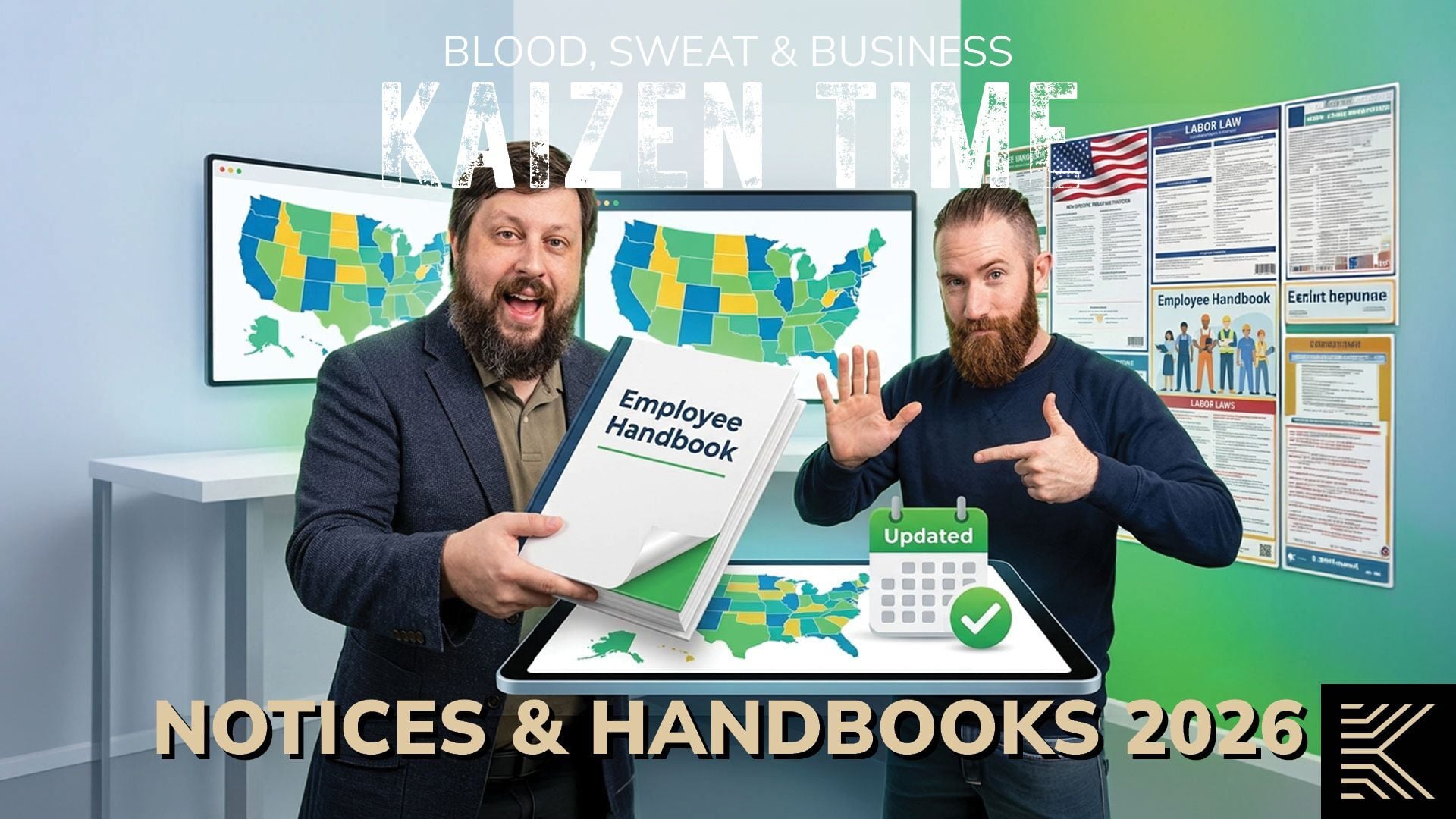
Employee handbooks and the posters in the break room get lumped together a lot. Paperwork. Compliance stuff. Something you set up once and forget about.
Confuse the two, and it's an easy way to end up with a fine that didn't need to happen.
One is about how your shop operates. The other is about what the law requires, whether you agree with it or not. Get either one wrong, and the cost isn't small.
Your employee handbook is about how your shop operates. It's your PTO policy, your attendance rules, your message to employees about how things work here. When you change something internally, like how PTO accrues, that's what triggers a handbook update. Most shops only touch theirs about once a year.
Legal notices are different. Those are the postings you see in the break room covering minimum wage, FMLA, OSHA, unemployment, and workers' comp. They're not about your policies. They're about what federal, state, and local agencies require you to tell your employees, whether you decided on it or not.
Notices come from a lot of different agencies, and they don't all update on the same schedule. OSHA can change a rule. Minimum wage can change at the state level and again at the city level. If you have a location in Springfield and one in Chicago, you're looking at two different minimum wage changes and two different posters, because Illinois and Chicago don't move on the same date.
Some notices barely change at all. Federal minimum wage hasn't moved in a long time, so that poster can stay up long after everything else in your break room has been swapped out. Others change constantly. That inconsistency is exactly why shops fall behind. It's easy to assume the whole board is current when really only parts of it are.
This is where it gets expensive. If an employee needed FMLA and you didn't honor it, that's thousands of dollars right there. Wage and overtime violations are worse. If you underpaid your team $50,000 over a year, in a lot of cases you're not just paying that $50,000 back. You could owe two to three times that amount, depending on jurisdiction, which could put you at $150,000 for something that started as an administrative gap.
Some of these penalties accrue daily or monthly, not just as a one-time fine. And it's not always a dramatic mistake that triggers them. It's often something as simple as an outdated poster or a handbook that never got updated to match a policy change.
If you have employees working in more than one state, the rules get more complicated. Employees are governed by the law of where they actually work, not where your company is headquartered. That means a remote employee in California still needs California notices and a handbook that reflects California requirements, even if your whole team is otherwise based in Illinois.
You also have to treat employees within the same jurisdiction as a group. You can't give one employee a different PTO policy than a coworker in the same state just because it's convenient. If you operate in two states, you can treat those locations as separate groups with their own policies, but you can't use a lighter-touch state as an excuse to scale back what you're giving employees in a jurisdiction that requires more.
And whatever you put in your handbook becomes the standard you're held to. If Tennessee doesn't mandate sick leave but your handbook promises it anyway, that promise supersedes what the law requires. That's exactly why shops with employees in multiple states usually need multiple versions of their handbook, not one generic version stretched across every location.
Can software alone keep you compliant? Mostly, for the routine parts. Most handbook vendors offer self-service tools that build out your policies, and when a law changes, like a new state leave policy, the software updates the generic language automatically. You still customize your specific PTO or leave policy on top of that, but you're not starting from scratch every time something shifts.
Where those tools stop is anything that doesn't fit the template. A question about how a leave request interacts with your attendance policy. A termination that doesn't look like the example in the software. A notice you're not sure applies to your second location. Generic tools don't have a place for those questions.
That's what YPD HCM's HR Essentials service adds. Along with the same kind of handbook self-service builder, it includes a federal and state employment law library, FMLA and state leave guidelines, and live HR support you can call when a question doesn't have a clean answer in the library.
Poster compliance works the same way. Subscription services track notice changes for you and send updated posters when something changes, instead of you finding out after the fact. Some services even handle notices by zip code for remote employees, so you're covered no matter where your team is actually working.
Compare that to the alternative. A subscription might run you somewhere around $50 a month. A single wage violation that turns into a $150,000 penalty makes that cost look like nothing.
Handbook and poster compliance isn't usually the thing that keeps shop owners up at night, until a fine shows up for something that should've been an easy fix.
If you're keeping up with this manually, let's talk through how YPD HCM can make payroll and HR compliance easier to manage.

New Employee Leave Laws Explained
Payroll Compliance Without Panic
Kaizen CPAs works with auto repair shops across the country. We know running a successful shop takes more than keeping the bays full. We help shop owners understand their numbers, stay ahead of taxes, and build stronger, more profitable businesses. Auto repair is at the heart of what we do, but we bring the same practical, hands-on approach to businesses in other industries, too.
YPD HCM is part of the Kaizen CPAs family. YPD HCM helps small businesses manage payroll, HR, and compliance with the right tools and personal, human support—from payroll and tax filings to onboarding, employee management, and more. It’s practical help for the people side of your business, from a team that’s there when you need them.
The information in this article is provided for general educational purposes and reflects conditions as of the publication date. It is not legal, tax, accounting, payroll, HR, or compliance advice. Every business is different, so talk with a qualified professional about your specific situation.
AI in the shop can sound like a robot running the front counter. But that’s not where the value is right now, and it probably isn’t where it should...

Every pay period, payroll comes due, and a lot of shop owners treat that number like any other bill. They see it, they pay it, and they move on...
Employee handbooks and the posters in the break room get lumped together a lot. Paperwork. Compliance stuff. Something you set up once and forget...