Business Valuation Tool for Auto Repair Shops
Find out what your shop is worth.
And how to make it more.
Most shop owners pick a number out of thin air — what they've put in, what a competitor sold for, what they heard at a trade show. This tool calculates what a buyer would actually pay, based on your real numbers and how your shop runs.
What You'll Know in Minutes
Your number. Your gap. Your next move.
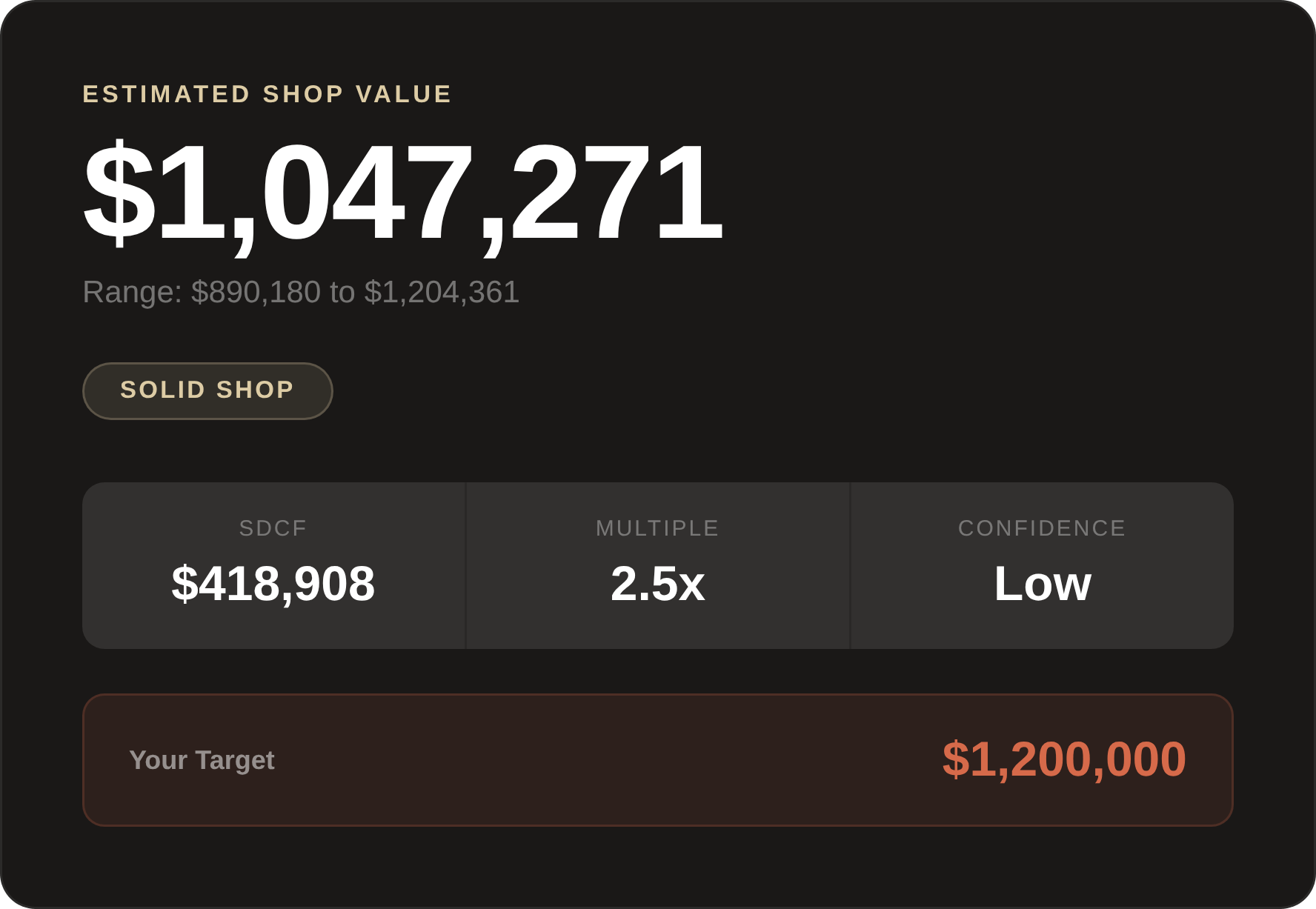
Your estimated shop value
Not a gut feeling or a competitor's sale price. A number based on your actual cash flow and how transferable your shop is to a buyer right now. Includes a range and a confidence level.
The gap to your target
Tell us what you want to walk away with. We'll show you whether you're already there, how far short you are, or whether you're underselling yourself without knowing it.
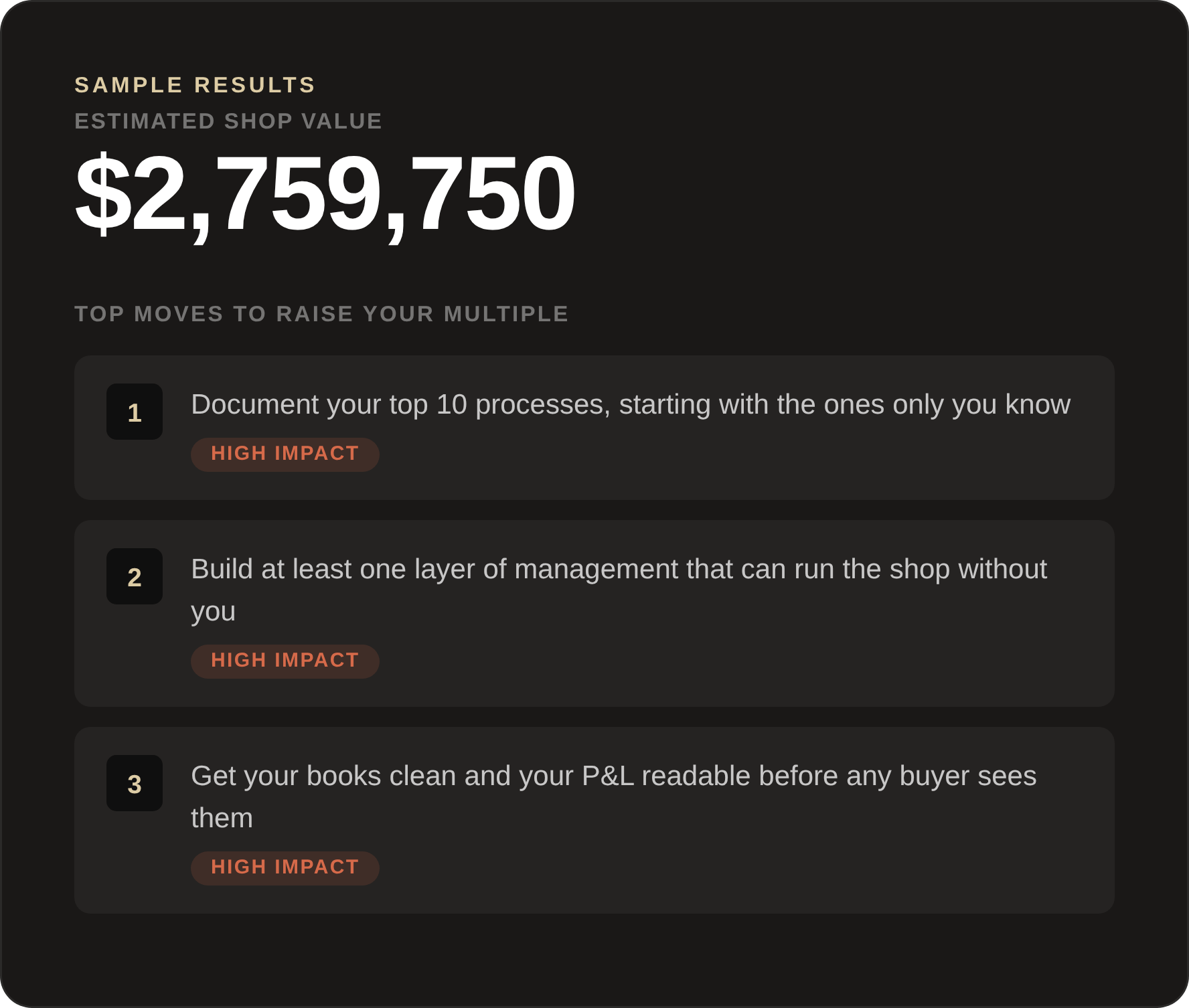
A ranked action plan
The full report doesn't give you a generic checklist. It maps the highest-leverage moves to where your specific shop scored lowest, so you know what to work on first.
How It Works
Three steps. Run it in minutes.
Enter your financials
Pull the numbers from your most recent P&L: net income, interest, taxes, depreciation, amortization, and any owner-related expenses running through the business. The tool calculates your SDCF as you type.
Answer seven questions
Seven questions about what a buyer would scrutinize: your SOPs, how much the shop depends on you, how stable your tech team is, whether your books are clean, and what you want to walk away with.
See your estimate
See your estimated value, where it lands against your target, and how far the right operational moves could take it. The full report shows you exactly where the gaps are and what to work on first.
Your Results
A clear picture of what your shop is worth today.
The on-screen results give you the number. The full report tells you what to do with it.
- Estimated shop value with range, calculated from your SDCF and a multiple based on your quiz answers.
- Your multiple and what's behind it, so you know which factors are holding it down.
- Gap analysis, showing where today's estimate lands against your target and your upside potential.
- 5 to 7 specific action items, ranked by impact and mapped to where your shop scored lowest.
- A printable PDF report you can share with a partner, an advisor, or keep for your own planning.
Common Questions
Good questions.
Straight answers.
-
What is seller discretionary cash flow?
Seller Discretionary Cash Flow (SDCF) is the total financial benefit the business generates for a working owner in a given year. It starts with net income and adds back interest expense, income taxes, depreciation, amortization, and any owner-related or non-essential expenses that wouldn't carry over to a new owner. It's the foundation of most small business valuations because it reflects the true earning power of the shop, independent of how the current owner has structured their finances.
-
How is an auto repair shop valued?
Auto repair shops, like any small business, are valued at risk times cash flow. Cash flow is measured using the Seller Discretionary Cash Flow (SDCF) number. Risk is represented by a multiple, which answers one question: how likely is it that the cash flow will continue after the sale? A buyer takes the shop's SDCF and applies a multiple based on how transferable and stable the business is. The stronger the systems, team, and financials, the higher the multiple. This tool calculates your SDCF and applies a multiple based on your quiz answers to give you a directional estimate.
-
How can I increase the value of my auto repair shop?
The biggest levers are reducing owner dependence, documenting your processes, stabilizing your team, cleaning up your books, and building a loyal customer base. Real estate matters too. Owning the property is a value driver, but buyers are often just as satisfied with a long, transferable lease (10 years or more) since it gives them confidence the location is secure without tying up additional capital. Each of these factors affects the multiple applied to your SDCF, which is where most of the value movement happens. The report from this tool identifies which of those areas represent the most upside for your specific shop.
-
Does owner dependence affect the sale price of a shop?
Yes, significantly. If a buyer believes the shop's value walks out the door with the owner, they'll price that risk into the offer. In some cases, a buyer will calculate what it would cost to replace the owner's role and reduce that amount directly from the SDCF before applying a multiple. Shops where the owner handles every customer call, approves every repair order, and holds all the relationships sell at lower multiples than shops with a capable team and clear processes in place.
-
How do documented SOPs affect shop value?
Documented standard operating procedures show a buyer that the shop can run predictably without the current owner. When processes are written down, a new owner can hand an employee a checklist and expect consistent results. That reduces risk, and lower risk means a higher multiple. SOPs don't have to be elaborate; even basic written processes for your most common workflows make a meaningful difference in how a buyer evaluates the business.
WHAT IS YOUR SHOP WORTH?
Know the number.
Then move it.
The estimate takes a few minutes. The report gives you a starting point for every conversation about your shop's future.
Free tool. Quick-look estimate only, not a formal valuation.