 Henry Joern
How Auto Repair Shops Can Use AI to Boost Profits and Efficiency
AI in the shop can sound like a robot running the front counter. But that’s not where the value is right now, and it probably isn’t where it should...
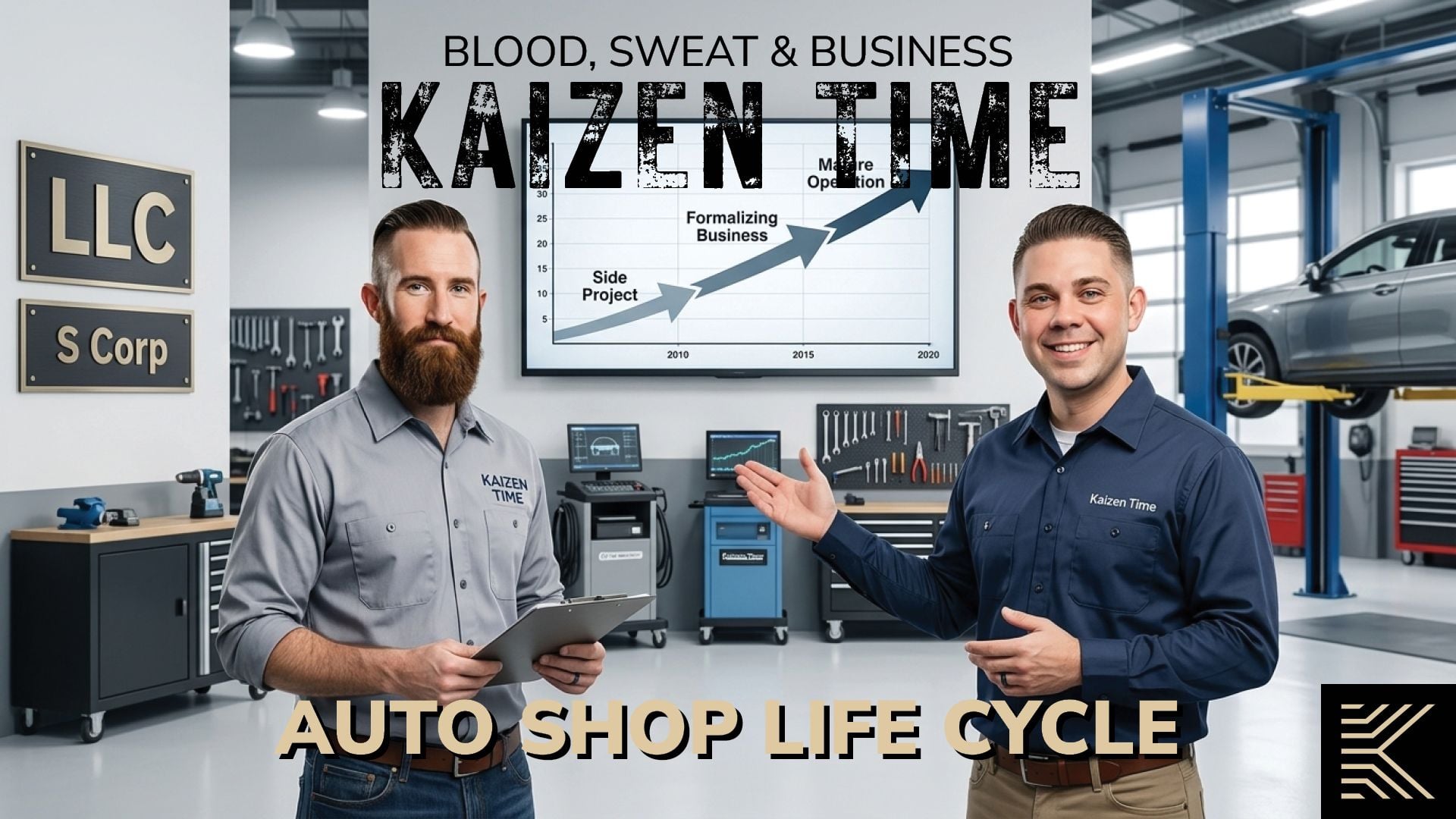
Every business, including yours, moves through stages. Someone learns a skill, gets good enough to sell it, and at some point makes the leap from doing the work to running a business that does the work. What happens after that leap follows a pattern that's more predictable than most owners realize.
For auto repair shops, that pattern shows up in fairly consistent ways: how the business gets financed, what legal and tax structure fits at each size, when the owner needs help running the back office, and eventually, where new ideas come from once the shop can't rely on the owner's instincts alone.
Knowing where your shop sits in that cycle, and what usually comes next, makes it easier to plan for the next stage instead of reacting to it.
Most people who start a shop are good at fixing cars first and running a business second. That's true whether it's a carpenter, a specialty contractor, or a mechanic. Someone does the actual skilled work, whether for someone else or on their own, and eventually decides they can build a business around it.
From there, the business grows, shrinks, or gets sold, depending on the owner, the economy, and a dozen other factors. But the stages in between, like informal work, formalizing the business, adding employees, choosing an entity structure, and eventually maxing out what a single location can support, tend to follow the same order for almost every shop.
In the earliest stage, a lot of shops aren't really a "business" in any formal sense. It's one person working out of a garage or a home shop, getting paid directly for the work. Even at this stage, that income is legally required to be reported to the government and tracked along with expenses. This early setup is typically a Schedule C filing on the owner's personal tax return, which isn't a separate legal entity at all.
The risk at this stage is personal liability. If something goes wrong on a job, even a small one paid in cash, the owner is personally on the hook. There's no legal separation between the person and the business yet.
One of the simplest and most valuable early moves is forming a single-member LLC. It still gets reported on taxes the same way as a Schedule C business, so there's no added tax complexity. What it adds is a layer of legal protection for the owner's personal assets, separating what happens in the business from what happens to the owner personally.
It's a low-cost step that most shop owners can take well before they're ready for anything more complex, and it's worth doing earlier rather than waiting until the business has more to protect.
Growth usually creates its first real inflection point when the owner brings on a second person. That decision tends to force two others right behind it: where to find more space (real bays, not a home garage), and how to pay for it.
Financing at this stage often comes from personal equity or from debt that's more expensive than it needs to be, mainly because the business doesn't have real books yet to support a stronger loan. That's usually the point where formal bookkeeping starts to matter, whether that's a QuickBooks file or another accounting system, along with a better way to track the events that generate revenue and payroll than a spreadsheet.
As a shop adds a partner or grows past the simplest structure, there's a real decision to make between a partnership and an S corporation. The right answer depends on what the owner actually needs.
If the primary goal is minimizing self-employment tax, and there's no real need for flexibility in ownership or how profits get split, an S corporation is usually the more straightforward option. Profits in an S corp are generally allocated based strictly on ownership percentage.
A partnership makes more sense when the owner wants flexibility: plans to bring in partners down the road, or profits that don't need to be split according to a fixed ownership formula every year. That flexibility can matter a lot once a shop has more than one owner with different roles or different levels of investment.
We've written in more detail about how the S-corp, partnership, and C-corp decision plays out for growing businesses, including where each structure tends to fall short: which entity type is right for your business.
As a shop adds employees, the owner eventually can't handle scheduling, invoicing, and the back office alone anymore. That's usually when a point-of-sale or shop management system comes in, along with an office manager or administrative hire to run the day-to-day paperwork the owner used to handle personally.
This is also where the right software starts to matter more than it did in the early stages. A shop running everything through a basic QuickBooks file can usually get by at low volume, but it becomes difficult to manage manually once the business is generating enough work to need real tracking.
If your shop is at the point where manual tracking is starting to break down, our breakdown of the leading shop management software options is a reasonable place to start.
A single shop at its largest, meaning the most it's likely to grow without adding a second location, tends to land somewhere in the $5 million to $10 million range in annual sales. At that size, a shop typically has someone dedicated to day-to-day bookkeeping and a shop management system running the operational side of the business.
In terms of headcount, that usually means somewhere around 20 to 30 people across the organization. It's a meaningful business, but it's still small, relative to the kind of company that has entire departments dedicated to strategy and new ideas.
A company like Amazon has an enormous workforce, giving it a deep bench of people generating and testing new ideas across the organization. A single auto shop owner, even at a mature, 20-to-30-person shop, doesn't have that same depth of internal perspective to draw from.
That's not a flaw in how the owner runs the business. It's simply a function of size. Once a shop has worked through financing, entity structure, and back-office systems, the next constraint on growth tends to be where new ideas come from, not whether the owner is working hard enough.
Once a shop has grown past what one owner can manage single-handedly, it's worth getting a coach who specializes in the auto repair industry specifically. Beyond direct advice, a good coach typically brings the owner into a group of other shop owners who are trading ideas: what's working, what isn't, and what to try next.
We've laid out what that decision actually involves, including the accountability it brings, what it tends to cost, and how to find the right fit, in Why Your Shop Needs a Business Coach to Grow.
This tends to matter most when growth has flattened, or the owner wants growth but isn't seeing it. That's also a good time to start attending industry trade shows. Trade shows put owners in front of other people actively trying to improve their own shops, along with vendors who can genuinely improve day-to-day processes, whether that's a shop management system or industry-specific software for a particular workflow.
We talked through what that kind of coaching actually looks like in practice in this conversation on how coaching transforms automotive shops, including how it helped one shop owner shift from just surviving to genuinely growing.
A life cycle doesn't end at maturity. At some point, most owners either sell the business, hand it to a partner or key employee, pass it to a family member, or wind it down. That stage tends to get less attention than the earlier ones, mainly because it feels far off, right up until it isn't.
The earlier stages actually set up this one. A shop with a real entity structure, clean books, and a working management system is a shop a buyer or a successor can evaluate. One that's still running informally, or where the numbers only exist in the owner's head, is much harder to hand off, no matter how good the day-to-day business actually is.
One of the first practical questions in any succession conversation is simply what the shop is worth today, before you're in the middle of an actual negotiation or a family conversation about who takes over.
Our shop valuation tool is a reasonable starting point for getting a directional number, whether a transition is a near-term plan or something you're just starting to think about.
Entity structure and back-office systems are easy to put off until a lender, a partner, or a tax bill forces the conversation. The stage your shop is actually in should drive those decisions, not the other way around.
If you're not sure whether your shop's structure, financials, and systems match where your business really is, let's talk and figure it out together.

EPA Responds to the Freedom to Fix Memo: What Changed for Your Shop
6 KPIs Every Auto Repair Shop Owner Should Track for Profitability
Kaizen CPAs works with auto repair shops across the country. We know running a successful shop takes more than keeping the bays full. We help shop owners understand their numbers, stay ahead of taxes, and build stronger, more profitable businesses. Auto repair is at the heart of what we do, but we bring the same practical, hands-on approach to businesses in other industries, too.
YPD HCM is part of the Kaizen CPAs family. YPD HCM helps small businesses manage payroll, HR, and compliance with the right tools and personal, human support—from payroll and tax filings to onboarding, employee management, and more. It’s practical help for the people side of your business, from a team that’s there when you need them.
The information in this article is provided for general educational purposes and reflects conditions as of the publication date. It is not legal, tax, accounting, payroll, HR, or compliance advice. Every business is different, so talk with a qualified professional about your specific situation.

AI in the shop can sound like a robot running the front counter. But that’s not where the value is right now, and it probably isn’t where it should...

Every pay period, payroll comes due, and a lot of shop owners treat that number like any other bill. They see it, they pay it, and they move on...
Employee handbooks and the posters in the break room get lumped together a lot. Paperwork. Compliance stuff. Something you set up once and forget...