Most shop owners aren’t thinking about selling their business when they’re in the middle of running it.
There are employees to manage, cars to get out the door, customers to take care of and bills to pay. Selling may feel like something you’ll worry about years from now.
But I think there’s a better way to look at it.
Your shop is always for sale.
That doesn’t mean you should be looking for a buyer. It means you should be building a business that someone else could buy, because many of the things that make a shop more valuable to a future buyer also make it a better business for you to own today.
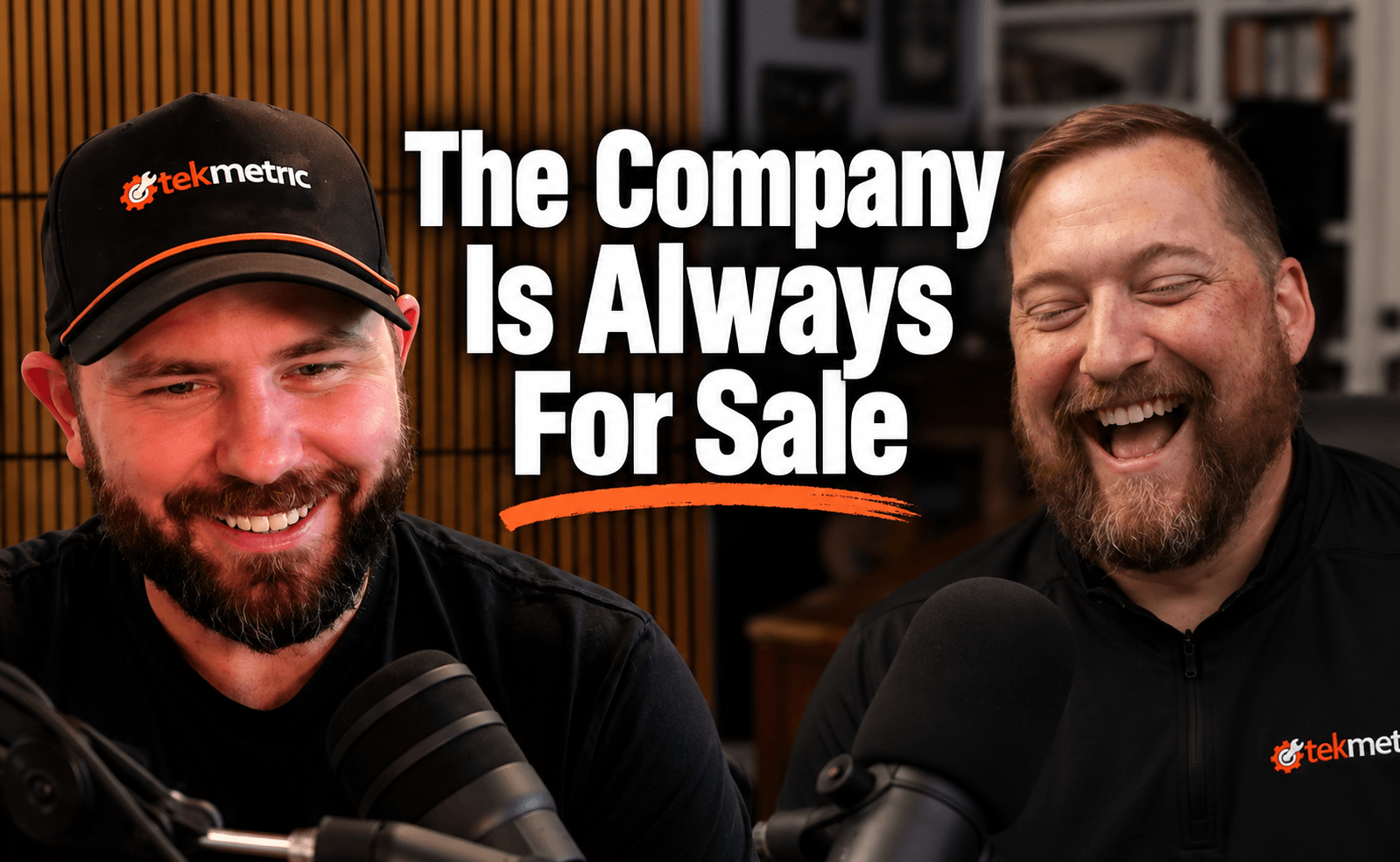
That idea came up in my conversation with Mike Allen, third-generation shop owner and co-owner of Carfix. Mike learned it pretty directly from his dad.
“I need you to understand that this corporation is for sale at all times.”
— Mike Allen
His dad wasn’t promising him the family business. Mike would have the opportunity to buy it, and even receive a family discount, but he was going to have to earn it.
That lesson shaped the way Mike thought about ownership. And there’s a lot in his story that applies whether you plan to sell to your child, transition the shop to a key employee, entertain an outside offer someday or keep owning it for another 20 years.
What Makes an Auto Repair Shop Sellable?
A sellable auto repair shop is a business that can continue producing reliable cash flow without depending entirely on its current owner.
That means a potential buyer is going to care about more than your revenue.
They’re going to care about profitability. They’re going to care about your books. They’re going to care about your people, processes, liabilities, and how much of the business walks out the door when you do.
That’s why I like the idea of running the business as though somebody could make you an offer tomorrow.
You may never accept that offer. But if one came, would you have a business somebody would actually want to buy?
If you’re curious what those factors could mean for your shop today, our auto repair shop valuation tool gives you a directional estimate based on cash flow, owner dependence, systems, team stability, and other factors a buyer is likely to consider.
Succession Planning Should Start Years Before You Want Out
One of the biggest mistakes I see in succession planning is waiting too long.
If you hope a manager, family member, or another key employee will eventually buy the business, that person needs time to prepare financially and operationally.
Think about the math. A good store manager may earn a solid living and still have a difficult time accumulating enough cash to make a meaningful down payment on a seven-figure business.
You can’t necessarily decide at 60 that you want to be out at 62 and expect an employee to suddenly be ready to buy you out.
Mike’s transition was different because his family had a plan.
He gradually purchased shares from his dad using an agreed-upon valuation formula. They revisited the value annually, and Mike bought additional ownership as he could afford it.
Eventually, he bought the remainder.
The important part wasn’t the exact formula they used. It was that there was a formula and a plan.
If there’s someone you think could eventually own your shop, start having those conversations early.
“You’re going to have to earn this.”
— Mike Allen
Selling to an Employee vs. Taking the Highest Offer
Private equity and consolidators have changed the conversation around auto repair shop exits.
An owner who once assumed the shop would go to a child or longtime employee may eventually have another option: an outside buyer willing to pay more.
There isn’t one answer that works for every owner.
In the conversation, I talked about a shop owner who had spent years preparing to transition the business to a manager. When we compared the economics of that arrangement with another potential path, the difference wasn’t enough to automatically outweigh what mattered to the owner about his legacy.
That’s a decision you can only make when you know the numbers.
What would an outside buyer realistically pay? What can an internal successor afford? What do you need financially from the sale? How important is it to you who owns the business next?
Those questions are much easier to answer while you still have options.
Revenue, Profit and Cash Are Not the Same Thing
This is one of those concepts that sounds obvious until you see how often it creates problems.
More revenue does not automatically mean more profit.
And more profit does not automatically mean more cash.
A shop can be growing rapidly and still put tremendous pressure on cash flow. You can also show accounting profit while wondering where the money went because cash is tied up somewhere else in the business.
Understanding those differences matters while you own the shop, and it matters when someone evaluates buying it.
A buyer isn’t simply buying your sales number. They’re trying to determine how much reliable economic benefit the business produces and how likely that performance is to continue.
If profit and cash still feel like they should be the same number, our article on profit vs. cash flow breaks down why they can tell you two different things.
Clean Books Become Even More Important When You Want to Sell
One of the quickest ways to complicate a sale is to have financials nobody trusts.
If the books are messy, a buyer has to figure out what the business actually earns. That creates uncertainty, and uncertainty creates risk.
Good bookkeeping isn’t just about filing an accurate tax return.
Your financials should help you understand how the shop is performing while you still own it. And eventually, they may need to help someone else understand what they’re buying.
That includes having a chart of accounts that makes sense for an auto repair business and consistently tracking the numbers that actually tell you something useful.
For multi-location shops, that becomes even more important. You need to be able to understand the performance of each location without creating so much accounting complexity that you can’t easily see the business as a whole.
If you want a deeper look at how those reports should be structured, see How to Organize Your Auto Repair Shop Income Statement.
Should Every Shop Location Have Its Own EIN?
This was one of the more technical parts of my conversation with Mike, but it raised an important point: business structure shouldn’t happen by accident.
Mike operates multiple locations using separate entities, along with a management company and a real estate holding company. That can provide flexibility, including the potential to separate a location in a future transaction.
But more entities can also mean more accounting, more tax returns, and more administrative complexity.
There can be legal, tax, and operational reasons to structure multiple locations in different ways. This is an area where your attorney and tax advisor should be involved because the right answer depends on what you own, how the businesses operate, and what you ultimately want to do with them.
The larger point is simpler.
Your structure should support where you’re trying to go.
If you’ve added locations over the years and accumulated LLCs, S corporations or EINs along the way, it may be worth asking whether the structure you have today still makes sense for the business you’ve become.
Buying a Shop? Know Exactly What You’re Buying
Mike also told one of the more memorable acquisition stories I’ve heard.
He bought the assets of a struggling shop for $20,000 cash and assumed the lease. The previous business had serious IRS problems, including unpaid payroll taxes.
Mike had created a new EIN, entered into an asset purchase agreement and established new vendor accounts. When the IRS later showed up, being able to document exactly what he had purchased mattered.
He’s also very clear that he doesn’t recommend trying to recreate that deal.
The lesson isn’t to go hunting for distressed shops with envelopes of cash.
It’s that the structure of an acquisition matters.
Buying assets is different from buying ownership in an existing entity. Purchase price allocation can have tax consequences for both buyer and seller. Existing liabilities can matter. Entity structure can matter.
That is why the accounting and legal work needs to happen before you sign the deal, not after.
Tax Planning Should Support the Business, Not Chase Write-Offs
Shop owners ask me about write-offs all the time.
And yes, we want to use every legitimate tax strategy available. But reducing taxes shouldn’t become an excuse for making bad business decisions.
Buying something you don’t need just because it creates a deduction still means you spent the money.
The same principle applies when you’re building toward a future sale. Tax planning, entity structure, compensation, and major purchases should fit into the larger financial strategy.
Your goal isn’t simply to produce the smallest possible tax bill this year.
It’s to build wealth and create a financially strong business.
Build a Business You’d Want to Buy
You don’t need to be preparing for retirement to start thinking like a future buyer.
Ask yourself:
If I were looking at this shop from the outside, would I trust the financials?
Could I understand how it makes money?
Does it produce consistent profit and cash flow?
Can it operate without the owner being involved in every decision?
Is there a strong team in place?
Are the systems repeatable?
Are there financial, tax, or legal issues I’d have to clean up after the purchase?
Those questions can expose weaknesses long before you put a shop on the market.
They can also make you a better owner right now.
You may sell to a competitor. You may sell to private equity. You may transition the business to a manager or your kids. You may decide you love what you’re doing and keep the shop for another couple of decades.
You don’t have to know today.
But building a business that gives you those choices is a pretty good place to start.
Hear the Full Conversation
Watch the episode above, or listen to Under the Hood CPA wherever you get your podcasts.
 Eric Joern