 Eric Joern
Should You Share Your Auto Repair Shop’s Financials With Employees?
Would you show your technicians and service advisors your shop’s profit and loss statement? For a lot of shop owners, that question brings up some...

Would you show your technicians and service advisors your shop’s profit and loss statement?
For a lot of shop owners, that question brings up some immediate concerns. What if employees see how much revenue the shop generates and assume you’re pocketing most of it? What if they start questioning what they’re paid or how you’re spending money?
I understand the hesitation. But here’s something worth considering: Your employees are already making decisions that affect your shop’s profitability. Wouldn’t you rather they understood the numbers behind those decisions?
I recently talked with Matthew Koppi of Koppinger Euro Service and Chad Whitley of Whitley Automotive about how they’ve brought their teams into the financial side of their businesses. They didn’t start by turning everyone into accountants. They started by helping employees understand where the money goes and what it takes to run a profitable shop.
I think there’s a strong case for sharing financial information with your team, provided you’re willing to explain what the numbers mean.
That doesn’t mean every employee needs access to every financial detail. It means giving them enough information to understand how the business works, what you’re trying to accomplish, and how their decisions affect the outcome.
A technician might see a $190 labor rate and assume the shop is making a fortune. A service advisor might discount a repair because they think there’s plenty of profit built into the price.
Without context, those assumptions make sense to them.
But a shop’s labor rate isn’t its profit. Revenue has to cover technician compensation, parts, benefits, equipment, insurance, and the other expenses of keeping the doors open.
When employees understand that distinction, they can start looking at the business differently.
Chad shared an exercise that I think is particularly useful.
He initially gave his employees a copy of the shop’s profit and loss statement. They looked at it, but the numbers didn’t mean much to them.
So he tried something different.
He took the P&L, converted the major expense categories into percentages, and explained what happened to every $100 that came into the shop.
Instead of looking at a financial statement with millions of dollars in revenue, employees could picture a $100 bill and see how much went toward running the business.
At the time, Chad’s shop wasn’t doing as well financially as everyone assumed. Once he accounted for the expenses, only about $2 or $3 remained from that $100.
That got their attention. It changed how employees looked at the shop's revenue.
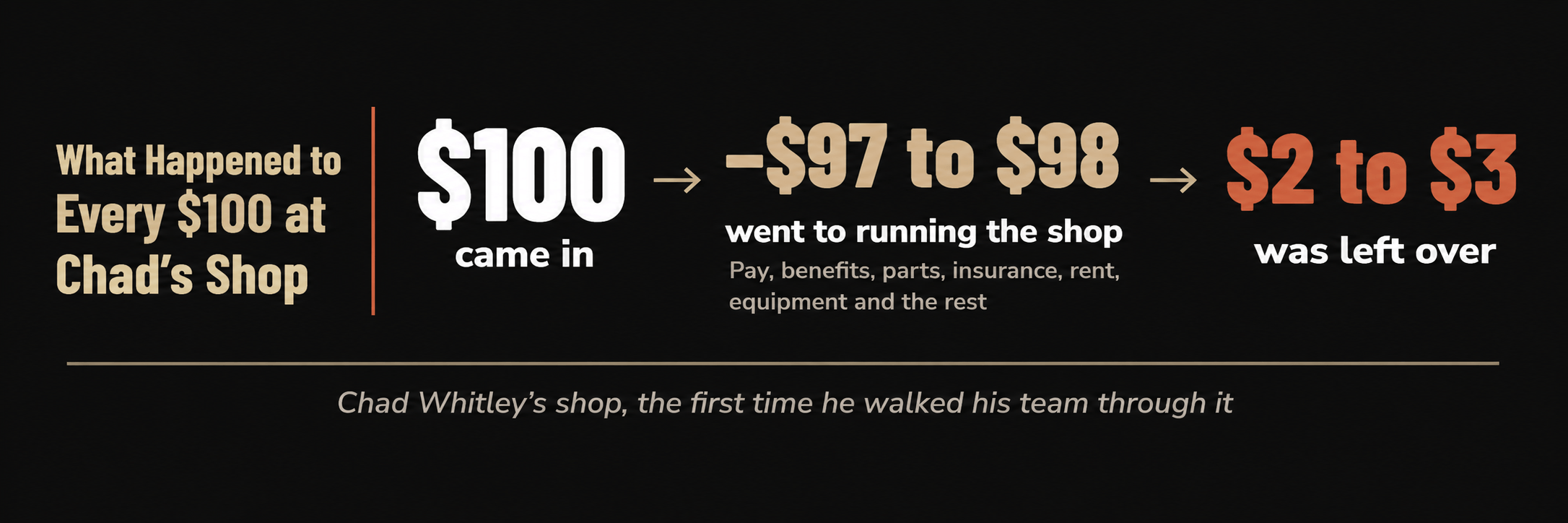
Chad made the discussion a quarterly routine. His team now has a better understanding of the P&L, including where wages and benefits appear and how those costs affect the bottom line.
“They don’t understand [where the money goes]. And the only way they’re going to understand that is if you show them.” — Chad Whitley
I like this approach because it makes the financials tangible. You don’t have to teach an accounting class. You just have to help people understand what happens to the money.
Sharing a P&L is a good starting point. But if you want employees to make better day-to-day decisions, they also need to understand the key performance indicators (KPIs) that drive those financial results.
Matthew’s approach grew out of his daily morning huddles. Initially, those meetings were about improving the shop’s culture. He started by asking employees to share something positive from the previous day.
As the culture improved, the conversations evolved into goal setting and financial education.
Matthew began reviewing KPIs with his team every morning, including car count, pace, closing percentage, and average repair order.
But he discovered something important: Putting numbers on a whiteboard doesn’t accomplish much if employees don’t understand what those numbers mean.
When his employees had trouble explaining the difference between gross profit and net profit, he walked them through the terminology and showed them how those numbers connected to the shop's performance.
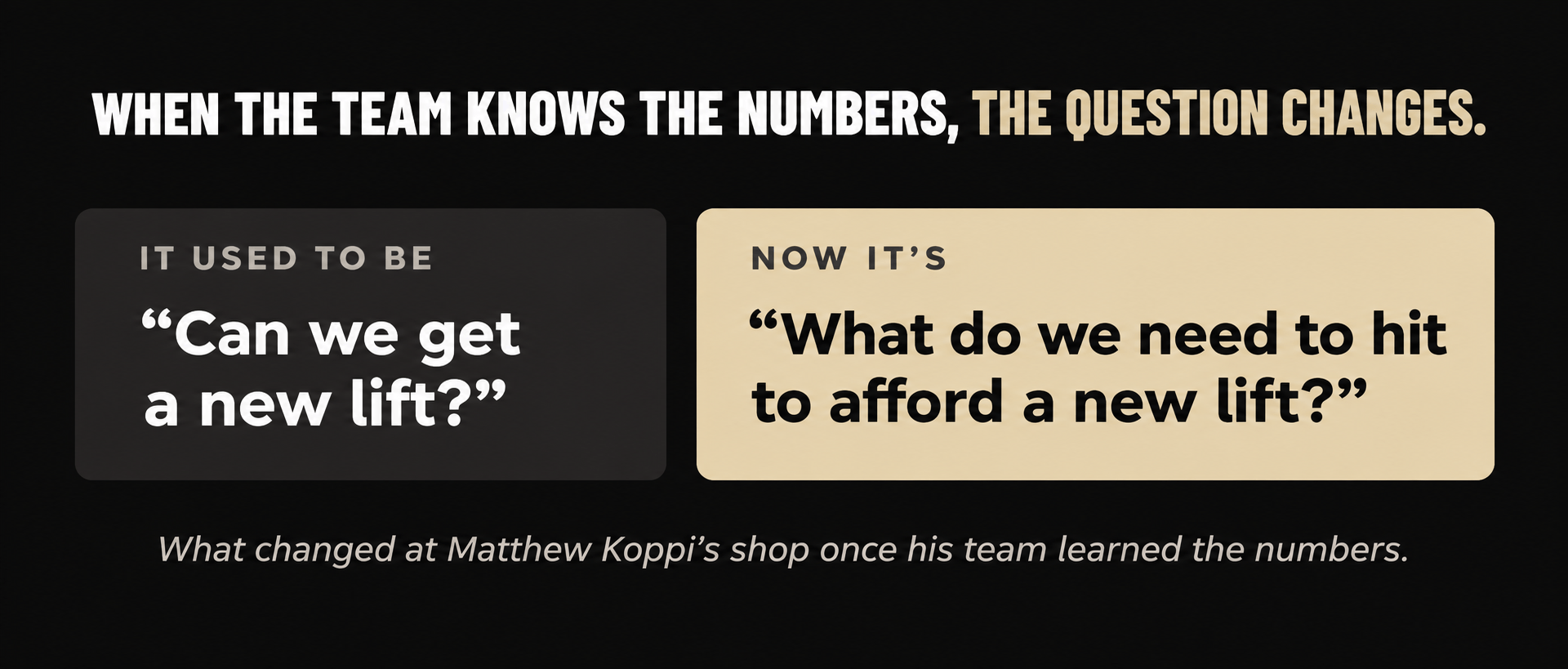
Over time, employees started asking better questions. Instead of simply asking for a new lift, they began asking what the shop needed to accomplish financially to afford one. That’s a pretty significant shift.
 Connect KPIs to Decisions Employees Make Every Day
One of the things I like about Matthew’s approach is that the KPIs aren’t just numbers the owner watches. His team understands why those numbers matter.
Take average repair order (ARO), for example. An increase in ARO may help the shop generate more revenue from its existing car count. But if that increase comes at the expense of gross profit margin, the shop might not be better off.
The same goes for closing percentage. Closing more work sounds great, but not if you’re discounting away the profit to get there.
That’s why I encourage shop owners to look at their monthly financial statements alongside their operational KPIs: https://www.kaizencpas.com/auto/auto-repair-monthly-financial-statements
You need to understand not just whether you’re producing more work, but whether that work is generating the gross profit your business needs. And your employees need enough context to understand how their work contributes to those results.
One of the most interesting parts of my conversation with Matthew and Chad was how financial transparency changed the way employees approached pricing.
Matthew explained that his service advisor will now challenge him if he starts making a pricing decision that could unnecessarily hurt the shop’s margins.
Think about that for a minute. Instead of the owner constantly reminding employees not to discount jobs, the employees are helping protect the business’s profitability.
Matthew said it used to be the other way around. A service advisor might reduce a price to avoid losing a job, believing there was enough profit in it. Now the team understands why protecting gross profit matters.
“They know the numbers. And the technicians, the service advisor, they’re all on board with keeping the margins correct.” — Matthew Koppi
You can set sales goals all day long. But if your team reaches those goals by sacrificing margin, you haven’t necessarily improved the business. Revenue and profit aren't interchangeable, and your team needs to understand that distinction when making pricing decisions.
For example, if you’re reviewing your parts gross profit, our Parts Pricing Matrix is one way to evaluate whether your pricing structure supports your margin goals.
The important part is connecting the financial target to decisions your team can actually influence.
Here’s where financial transparency gets more uncomfortable. It’s one thing to show employees a profitable P&L. It’s another to explain that the shop lost money.
Chad shared that his business had a difficult year and finished with a loss. He didn’t hide it from his employees.
He showed them what was happening, explained the challenges, and talked about what the shop was doing to improve.
His employees understood why certain expenses had to wait, including equipment purchases. They also understood why raises weren’t financially realistic at that point.
Chad said he didn’t lose anyone from his team during that difficult period.
Sharing your financials doesn't guarantee employees will stay when times get tough. But Chad's experience shows how an honest explanation can help employees understand difficult decisions and see the progress the shop makes afterward.
Chad described how his team now knows what financial milestones need to be reached before the shop can replace certain equipment. They’re part of those conversations.
That reminded me of something I’ve discussed with shop owners before: connecting a financial goal to something employees actually care about.
Let’s say you want to install air conditioning in your shop, and the project will cost $50,000.
You can work backward from that investment to determine what the business needs to generate in gross profit and cash after covering its other obligations.
Then connect that financial target to the car count, billed hours, and other operational metrics your team tracks. You could even put a progress thermometer on the wall.
Now employees aren’t just hearing that they need to produce more billed hours. They understand what they’re working toward.
Of course, you need to make sure the target accounts for your operating expenses, cash needs, and a reasonable return for the business. More sales alone don’t mean you can afford a major purchase.
But when the math works, connecting a financial goal to a tangible improvement can be a powerful way to build buy-in.
When I talk with shop owners about financial transparency, the biggest objection is usually fear.
They’re worried employees will misunderstand the numbers, question their compensation, or assume the owner is making more money than they really are.
Matthew described hearing a shop owner say he didn’t want employees in his pocket. His response was that employees are already making assumptions about how much money the owner has. They just don’t know whether those assumptions are accurate.
I think there’s a lot of truth in that. Keeping the numbers private doesn’t necessarily prevent employees from forming opinions about the business. It just means they’re forming those opinions without the financial context.
And sometimes the owner doesn’t fully understand the numbers, either.
That’s something I see in my work with auto repair shops. Owners can be excellent technicians and operators without having a strong understanding of their P&L.
There’s no reason to be embarrassed about that. But there is a reason to do something about it.
Before you can explain the numbers to your team, you need to understand them yourself. Start with gross profit, operating expenses, and net profit. Know how those figures connect to the work moving through your bays.
You don’t need to explain every account on your financial statements. Focus on the numbers that help employees understand how the business operates.
Absolutely. And this is something Matthew emphasized near the end of our conversation.
You don’t need a large team or multiple locations to start helping employees understand the business.
Even if you have one employee and you’re still working on the shop floor every day, you can explain a few important KPIs and connect them to a realistic goal.
Maybe you want to hire another technician. Maybe you want to get yourself off the floor a few hours each week.
Whatever the goal, you need to know where the business stands today and what has to change to make that goal possible.
Matthew talked about the difference between setting an ambitious goal and having a plan grounded in actual numbers.
Saying you want to grow from $150,000 to $1 million in revenue doesn’t tell your employee how you’re going to get there.
Showing them the numbers, explaining what needs to improve, and building a realistic plan gives them something they can participate in. And when employees understand where you’re going, they have a much better chance of helping you get there.
If you’ve never discussed your financials with employees, I wouldn’t start by handing everyone a full P&L and expecting them to figure it out. I’d start with one conversation.
First, make sure you understand your own numbers. You should be able to explain where revenue goes, what gross profit means, and what the business needs to cover its expenses.
Then make those numbers understandable. Chad’s $100 exercise is a great example. Take your actual financial results and show employees how much of each $100 goes toward the major expense categories.
From there, choose a few KPIs that employees can influence through their daily work. Explain what those metrics mean and why you’re tracking them.
Keep talking about the numbers. Let employees ask questions, and connect improvements to the goals you’ve set for the business.
You don't need to share everything at once. Start with a few meaningful numbers, explain what they tell you about the business, and build from there.

For me, financial transparency isn't simply about showing employees how much revenue the shop generates. It's about helping them understand what it takes to earn a profit and how their work contributes to that result.
As a CPA, I want shop owners to use their financial statements to make decisions, not just review them after the month is over. And I think there's real value in bringing employees into that understanding.
Matthew and Chad have shown what that can look like. Their teams aren't just hearing about financial goals. They're learning what drives those numbers and how they can help the shop reach them.
Knowing your numbers matters. Making sure the people working toward your goals understand them can make a difference, too.
Matthew Koppi and Chad Whitley share how they’ve introduced financial transparency in their shops, the questions their employees started asking, and the changes they’ve seen in their teams.
Watch the full conversation or listen to Under the Hood CPA wherever you get your podcasts.
At Kaizen CPAs, we help auto repair shop owners understand what their financials are telling them and use that information to make better business decisions.
If you’d like help connecting your shop’s financial performance to your operational goals, book a strategy call to start the conversation.

Kaizen CPAs works with auto repair shops across the country. We know running a successful shop takes more than keeping the bays full. We help shop owners understand their numbers, stay ahead of taxes, and build stronger, more profitable businesses. Auto repair is at the heart of what we do, but we bring the same practical, hands-on approach to businesses in other industries, too.
YPD HCM is part of the Kaizen CPAs family. YPD HCM helps small businesses manage payroll, HR, and compliance with the right tools and personal, human support, from payroll and tax filings to onboarding, employee management, and more. It’s practical help for the people side of your business, from a team that’s there when you need them.
The information in this article is provided for general educational purposes and reflects conditions as of the publication date. It is not legal, tax, accounting, payroll, HR, or compliance advice. Every business is different, so talk with a qualified professional about your specific situation.
Would you show your technicians and service advisors your shop’s profit and loss statement? For a lot of shop owners, that question brings up some...

A busy shop can look like a successful shop. Cars are coming in, the phones are ringing, and everyone is working. But when you look at the numbers,...

When we looked at Lucas Underwood's financials, one expense immediately stood out: nearly $15,000 in warranty costs. That number prompted Lucas to...