 Eric Joern
What Does Losing a Good Technician Really Cost Your Shop?
Finding a good technician is hard. Losing one can be even harder, especially when you start looking at what that empty bay is actually costing your...

Finding a good technician is hard. Losing one can be even harder, especially when you start looking at what that empty bay is actually costing your business.
But here’s something worth considering: What if your biggest hiring problem isn’t finding qualified people? What if it’s the process you’re using to hire them and then give them a reason to stay?
Most shop owners understand that replacing an employee costs money. Recruiting takes time, and it isn't always cheap. But those costs are only a small part of the picture.
What happens to your revenue while that position sits empty? How much pressure does it put on the rest of your team? And what happens when you finally hire someone, but it takes another three months to get them fully integrated into your shop?
I recently sat down with Bill Haas and Sara Fraser of Auto Ignite Management on Under the Hood CPA to talk about recruiting, retention, and the things shop owners often overlook when it comes to their employees.
One thing became pretty clear: The most expensive part of employee turnover isn’t necessarily finding someone new. It’s everything that happens between losing a good employee and getting your shop back to where it was.
The cost of replacing an auto repair technician includes recruiting expenses, lost gross profit from unfilled capacity, reduced productivity, onboarding, and the time it takes a new employee to become fully effective.
And those costs can add up quickly. Bill walked through an example that I think every shop owner should consider.
Let’s say your shop generates $200,000 per month in parts and labor sales with four technicians. For simplicity, we’ll assume each technician contributes equally to that revenue. That means each technician is responsible for approximately $50,000 in monthly sales.
Now, one of those technicians leaves. If you can’t redistribute that work to your remaining employees, you’ve potentially lost $50,000 in monthly revenue-producing capacity.
But here’s where I want shop owners to pay attention. It’s not just the lost revenue that concerns me. It’s the lost gross profit.
At a 60% gross profit margin, that $50,000 in sales represents approximately $30,000 in gross profit. That's $30,000 in gross profit that would have helped cover your operating expenses. And those expenses don't disappear just because you're short a technician.
Now consider how long it takes to fill that position. Sara explained that three to five months is a realistic recruiting timeline in her experience. That’s a long time to operate below capacity.
Using our simplified example, here’s what three months of lost production could look like.
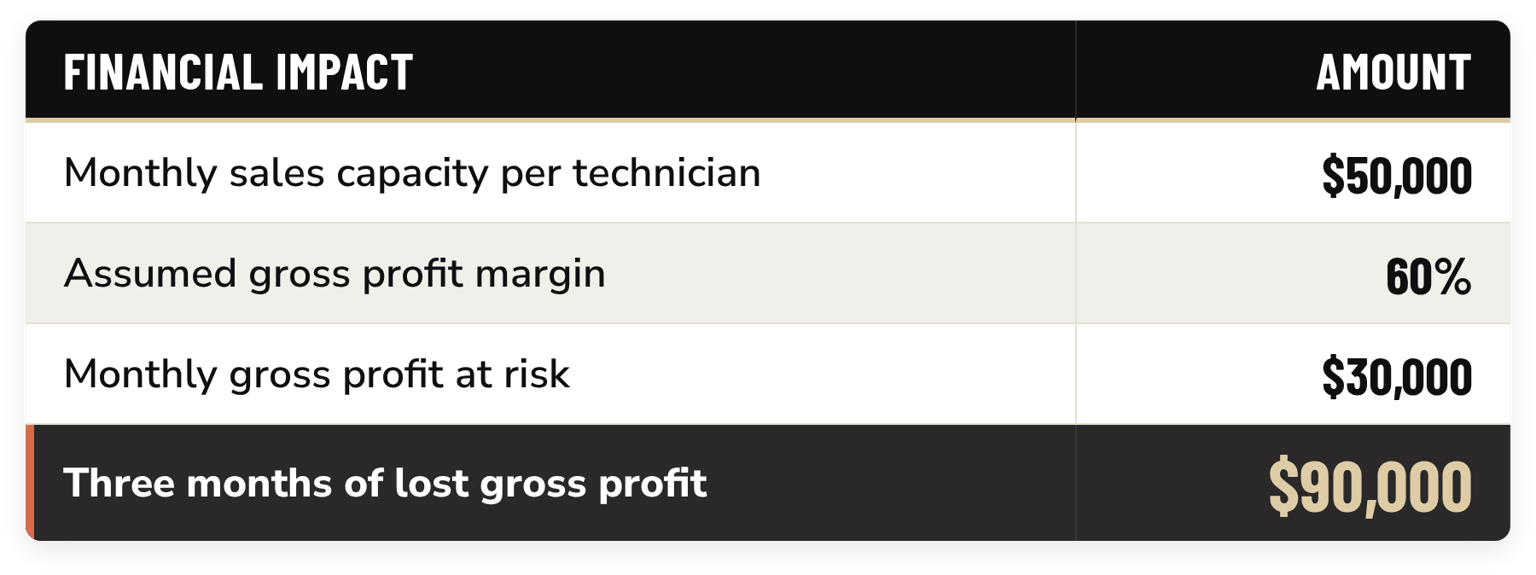
That’s potentially $90,000 in lost gross profit before we account for recruiting expenses, reduced productivity during the employee’s final weeks, or the time required to train a replacement.
Of course, this assumes you have enough customer demand to keep that technician busy, and your remaining team can’t absorb the work. It also assumes the 60% gross margin reflects the contribution from those sales. Every shop’s actual financial impact will be different.
Still, you can see why an employee leaving can become a six-figure problem. And there’s another piece that often gets missed. When you finally fill the position, the new employee probably isn’t going to be as productive as the person who left on day one.
They need to learn your shop management system, your processes, your expectations, and how your team operates. That’s why the cost of turnover doesn’t end when the new employee starts.
When we talk about improving shop profitability, we spend a lot of time discussing labor rates, technician productivity, parts margins, and car count. Those are important numbers.
But what about the cost of keeping your best employees? Bill brought up an interesting question during our conversation: What are shop owners doing to create reasons for their good employees to stay?
We often approach staffing as a recruiting problem. Somebody leaves, so we need to find somebody else. But what if we spent more time figuring out why people leave in the first place?
Sara pointed out that compensation isn’t always the biggest factor. In her recruiting conversations, employees frequently place work environment and communication ahead of pay.
They’re looking for reasonable schedules, opportunities to grow, honest feedback, and a workplace where they feel valued. That’s worth thinking about because many of those things don’t require a substantial financial investment. They require intentional leadership.
One of the most interesting parts of our discussion was how a shop’s treatment of underperforming employees can affect its strongest performers.
I’ve seen this firsthand when reviewing technician productivity. In one shop, I was looking at a technician consistently producing 70 to 75 billed hours per week. Another technician was averaging only 18 or 19 hours, with one week as low as seven.
When we looked at the effective labor cost per billed hour, the difference was substantial. The highly productive technician was costing the shop approximately $34 per billed hour, while the lower-producing technician was costing closer to $55 to $60.
That’s a significant financial difference. But there’s also a people problem. Imagine being the technician consistently producing 75 hours while the person working next to you is producing a fraction of that amount. What message does it send when management doesn’t address the difference?
Bill added another perspective. Sometimes the most skilled technician is constantly assigned the difficult diagnostic work while another employee gets the straightforward, high-production jobs. That can create frustration, too.
And he’s right. Productivity numbers need context. You can’t evaluate technicians fairly without considering the work they’re being assigned, their skill levels, and their opportunities to develop.
If you continually put your best people in difficult situations without recognizing their contributions, you risk losing the employees you can least afford to replace.
Here’s something I found particularly interesting about Sara’s approach to recruiting. When she sees a resume showing five jobs in seven years, she doesn’t automatically dismiss the candidate as a job hopper. She wants to know why.
Maybe that person hasn’t found the right environment. Maybe an employer made promises that were never fulfilled. The point is that the resume doesn’t tell the whole story.
And I think there’s a lesson for shop owners here. If employees are repeatedly leaving your business, is it possible they’re experiencing something you haven’t addressed?
Bill talked about how frequently employees are promised performance reviews that never happen. Someone is told they’ll receive feedback after 90 days, but six months go by without a conversation.
Employees want to know how they’re doing. They want to know what’s expected of them and where they can improve. That’s not the same as communicating about repair orders or which vehicle needs to be finished by Friday. It’s communicating about the person.
When you give employees honest feedback and follow through on your commitments, you give them more reason to see a future with your shop.
Another mistake we discussed is hiring without clearly defining what the shop actually needs. Sara said shop owners frequently come to her saying they need an A-level technician. But what does that mean?
Are you replacing someone who retired? Are you adding capacity because the business is growing? Or are you trying to fill the same position for the fourth time in 18 months?
Those are very different situations. And if you keep hiring for the same position, it might be time to ask why people aren't staying.
And if you’re repeatedly replacing employees in the same position, you might have a problem that recruiting alone won’t solve.
Before you post another job ad, you need to understand the role you’re trying to fill and what success looks like. That includes the technical requirements, but it also means understanding the person’s attitude, motivation, coachability, and fit with your team.
Sara explained that Auto Ignite Management uses detailed assessments on both sides of the hiring process. Shop owners define the skills and capabilities they need, while candidates complete corresponding inventories of their experience.
The goal isn’t simply to find someone with the right qualifications on paper. It’s to understand whether the person and the shop are a good match.
Compensation is another area where I think financial planning and hiring need to work together.
If you’re hiring a technician on a flat-rate or production-based pay plan, you need to be able to explain how that compensation works. What can the employee realistically expect to earn? Will there be enough work available? How does the pay structure reward performance?
And just as importantly, can your shop afford the arrangement while maintaining healthy labor margins?
This is where understanding your labor costs and technician productivity becomes important.
Bill also cautioned against treating starting compensation as a negotiation simply to see whether you can hire someone for less than they’re requesting. His point was that you should understand what the candidate needs and whether the opportunity makes sense for both sides.
I agree with the bigger principle. Hiring should be based on a compensation plan that works financially for the business and is attractive, understandable, and sustainable for the employee.
You don’t want to make a hiring decision that creates a profitability problem. But you also don’t want to lose the right candidate over a relatively small difference without understanding what that decision could cost you.
Let’s say you’ve found the right person, agreed on compensation, and they’re ready to start Monday. Now what?
If your onboarding process consists of introducing them to the team, showing them where the coffee machine is, and handing them their first repair order, you’re missing an opportunity.
Even experienced technicians need time to learn how your particular shop operates. Sara explained that onboarding is a major part of retention because employees need to be set up for success rather than expected to immediately perform at the level of the person they replaced.
Bill suggested that three months can be a reasonable minimum for someone to become oriented to a new shop. That doesn’t necessarily mean they’re fully productive after three months. It means they’ve developed a working understanding of the business.
Think about that from a financial perspective. If you’re already losing production while a position is vacant, and then your replacement spends additional months working below full capacity, the financial impact can extend well beyond the recruiting period.
A structured onboarding process can help shorten that learning curve.
I'm talking about having clear expectations, documented procedures, and someone responsible for helping that new employee get up to speed. They need to understand how your shop operates, and you need a way to know whether they're making progress.
You don’t need to create something overly complicated. But you should have a repeatable process that helps a new employee understand what success looks like. And that process shouldn’t stop after the first week.
Here’s something I think we need to talk about more often. Most shops budget for equipment, insurance, rent, payroll, and other operating expenses. But how many have a specific budget for recruiting and employee retention?
Bill mentioned working with shops that now allocate approximately $10,000 annually toward talent acquisition. That doesn’t mean $10,000 is the right number for every business. It means those shop owners have recognized that maintaining a strong team requires resources, and they’re planning accordingly.
I think that’s the important part. If recruiting is something you only think about when an employee gives notice, you’re already reacting to a problem.
Instead, consider what it would look like to include hiring and retention in your annual financial planning. That might mean budgeting for recruiting or investing more in the employees you already have.
It might also mean reviewing your financial statements to understand whether your current staffing model is producing the results you expect.
Your monthly financial statements should help you see how labor costs, gross profit, and operating expenses are affecting the business. When you combine that financial information with technician productivity and staffing data, you can make better decisions about where to invest.
And sometimes, investing in the employees you already have is the most economical decision you can make.
At the end of our conversation, I asked Bill and Sara for one thing a shop owner could do immediately to improve recruiting or retention.
Sara’s answer was straightforward: Have job descriptions. Define the responsibilities, expectations, and requirements of each position. That helps you hire the right people, but it also gives your existing employees a clearer understanding of their roles.
Bill’s advice was just as simple.
“Find out what your people need and make sure they get it.” — Bill Haas, Auto Ignite Management
I think those two recommendations work well together. You need to understand what your business expects from employees, and you need to understand what employees expect from your business.
That doesn’t mean you can meet every request. You still have to operate a financially sustainable shop. But you can have the conversations.
Employees want reasonable schedules, honest feedback, and to know their work matters. And while compensation is important, not everything that makes someone want to stay comes down to money.
Sometimes it comes down to whether you're listening.
There’s a reason we talk so much about preventive maintenance in the automotive industry. Addressing problems early is usually less expensive than waiting for something to fail. I think the same principle applies to managing your team.
When a productive technician leaves, you’re not just losing an employee. You’re potentially losing months of revenue-producing capacity, disrupting your workflow and placing additional pressure on the people who remain.
And getting back to full productivity can take longer than you expect. That’s why I believe employee retention deserves a place in your financial strategy, right alongside labor pricing, parts margins, and expense management.
You can't eliminate turnover. But you can give good employees a reason to stay and prepare your business for the times they don't.
That’s a much better position to be in than waiting until a technician gives notice to start figuring out what comes next.
Watch the full conversation above with Bill Haas and Sara Fraser of Auto Ignite Management as we discuss the real cost of employee turnover, what technicians are looking for in an employer, and how shop owners can improve their hiring and retention processes.
You can also listen to Under the Hood CPA wherever you get your podcasts.
Your technicians have a direct impact on your shop’s revenue, gross profit, and overall financial performance. But knowing what you’re spending on payroll is only part of understanding whether your staffing model is working.
At Kaizen CPAs + Advisors, we help auto repair shop owners understand their numbers and make informed decisions about profitability, staffing, and growth.

Kaizen CPAs works with auto repair shops across the country. We know running a successful shop takes more than keeping the bays full. We help shop owners understand their numbers, stay ahead of taxes, and build stronger, more profitable businesses. Auto repair is at the heart of what we do, but we bring the same practical, hands-on approach to businesses in other industries, too.
YPD HCM is part of the Kaizen CPAs family. YPD HCM helps small businesses manage payroll, HR, and compliance with the right tools and personal, human support, from payroll and tax filings to onboarding, employee management, and more. It’s practical help for the people side of your business, from a team that’s there when you need them.
The information in this article is provided for general educational purposes and reflects conditions as of the publication date. It is not legal, tax, accounting, payroll, HR, or compliance advice. Every business is different, so talk with a qualified professional about your specific situation.
Finding a good technician is hard. Losing one can be even harder, especially when you start looking at what that empty bay is actually costing your...
More cars. Higher repair orders. More revenue. That's usually where the conversation starts when a shop owner tells me they need to make more money....

You've found an auto repair shop for sale. The location is good, the equipment looks decent and the owner is ready to retire. Maybe you've worked...